|
KARMAZINAI COGNITIVE WALKWAY
Distance from Vilnius ~22 km Length of the walkway ~ 4,00 km It will take you 2,5 hours to go along the walkway
Karmazinai cognitive walkway is intended for people to get acquainted with the Neris river flowing in the forested valley, the diversity of stands, and the mythological-historical importance of the river. While travelling one can see the most important nature and culture values of the landscape reserve, learn about the burial customs of ancient Lithuanians, raft floating, which prospered a long time ago, plants and animals.
Karmazinai cognitive walkway is 4 km long. It will take you about 3 hours to cover all the path. You will find 19 information stands and 4 places where one can have a rest.
Attention! Trash cans are installed only at the beginning and end of the path. Therefore we ask visitors to leave waste there or to take it with yourselves.
The values of Karmazinai cognitive walkway:
 |
1. FOREST You are in the forest of Velniakampis landscape reserve in the Neris Regional Park. Today in Lithuania forests grow in the area of 2,05m ha. About 77% of Lithuanian forests grow naturally, other ones are planted. Since ancient times forests have been especially important for Lithuanian culture. It is said that in the forests some mysterious Lithuanian spirit hides and that they are our nation’s home. |
 |
2. GRASS SNAKE AND SLOW WORM Reptiles prevailing in these forests - grass snake (Natrix natrix) and slow worm (Anguis fragilis) – are non-venomous and absolutely harmless. Unfortunately, they often are mistaken for snakes, and because of that, they are killed by people not rarely. In ancient Lithuanian religions, fairy tales and stories exceptional attention has been paid to snakes and grass snakes. |
 |
3. KARMAZINAI PINEWOOD Pinewoods cover the majority of areas of Lithuanian forests (38%) (in the Neris Regional Park, they cover even 80% of all the forested area of the park). In Karmazinai pinewood, where you are at the moment, the age of the pines is 100 – 120 years, and their average height is about 30 metres. |
 |
4. KARMAZINAI BARROW YARD Karmazinai barrow yard is the biggest in Vilnius District. Barrows here are scattered in the area of 10 ha. In Karmazinai barrow yard, people were buried in the 5th – 8th centuries. After the archaeological explorations, three barrows were restored here and they are the only in Lithuania. |
 |
5. MYTHOLOGY OF THE NERIS Today it is difficult to explicitly explain what the Neris meant for our ancestors, but no doubt this river is to be linked with burial customs. One of the most important arguments is the abundance of groups of barrow yards (the 5th – 10th centuries) on the banks of the Neris. One version to be considered is that in the 2nd – 4th centuries the inhabitants of big settlements by the Neris could have buried unburnt dead bodies putting them down into the river, because the settlements of this period are found, however burial places are not. |
 |
6. TIMBER RAFTS IN THE NERIS Timber rafts (logs tied together) were drifted down the River Neris almost up until the middle of the 20th century. From the river highland they were drifted to Kaunas, and then down the Nemunas to Klaipėda. From there timber was transported farther by ships to England or Germany. |
 |
7. FISHES IN THE NERIS In the Neris, about 40 fish species are found and even 14 rare fish species are registered, which are protected at Lithuanian and European levels. With a view to increasing rare fish populations in the Neris, every year, salmon (Salmo salar) and sea trout (Salmo trutta trutta) parr is released. |
 |
8. BEAVER A beaver is the biggest rodent in Lithuania. Because of its specific way of life, beaver is the only representative of our country fauna, having a great influence on the environment. At the beginning of the 20th century, in Lithuania, beavers were almost extinct. Now their population is fully recovered, and in Lithuania beavers are common in places suitable for them. |
 |
9. POLLUTION OF THE NERIS The water of the Neris has become much cleaner in recent years. So that one could bathe in the Neris without fear, wastewater treatment facilities should be built not only at the bigger cities but also in every village. Unfortunately, so far every spring the waters of the Neris has been bringing a vast mass of plastic packaging to the regional park. |
 |
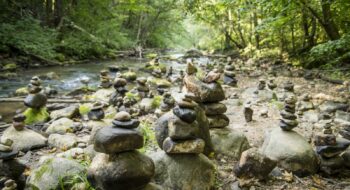
10. MYTHOLOGICAL STONES After the Christianization of Lithuania in 1387, the objects of the old Lithuanian religion were being destroyed, and only those monuments survived, which were in secluded places. In the territory of the regional park, there are about 27 stones and their groups, which, judging from stories, could be related to old religions. Most often they are stones lying in the Neris bed or close to it. The majority of stories are about stones with man's footmarks, with holes of different size and of unknown origin, as well as about huge stones, which, according to stories, are people turned into stones. |
 |
11. VELNIAKAMPIS In the Neris Regional Park there are 11 nature reserves, the biggest of which is Velniakampis landscape reserve (its area is 3249 ha). The axis of the lanscape reserve is the great turn of Velniakampis, which looks like a mushroom and the length of which is 16 km while the width at the isthmus is only 2 km. |
 |
12. PERENNIAL HONESTY Perennial honesty (Lunaria rediviva) is a perennial grassy plant growing from 30 to 140 cm high and blooming in May-July (the blooms are very fragrant). Perennial honesty is a plant getting rapidly endangered in Lithuania, therefore it is enlisted in the Red Data Book of Lithuania. |
 |
12. KEY FOREST HABITAT In front of you, in the lower terrace of the Neris, you can see a wet forest of black alders (its area is 4,7 ha). This forest area is distinct as a key forest habitat. In this habitat old black alders are massively overgrown with lichens and moss, there is a lot dead wood and wood phellinus species. |
 |
14. SEED FOREST STAND OF PEDUNCULATE OAK Seed forest stand of pedunculate oak is a forest, where productive oaks grow bearing sturdy acorns. Oaks, which are grown from the acorns of local oaks, are stronger and more resistant to changes of temperature and hydrological regime. Pedunculate oak has abundant harvest every 3 – 4 years. In harvesting years, one can collect up to 1000 – 2000 kg/ha acorns. |
 |
15. RED OAK There are about 600 oak species in the world. In Lithuania, 2 species grow naturally. Beside these species, about 20 introduced ones grow in Lithuania (which have been brought from other places). One of them is red oak (Quercus rubra). This oak originates in North America. The most distinct feature between red and pedunculate oaks is the form of their leaves. | |
 |